sommaire
🇫🇷 version francaise 🇫🇷
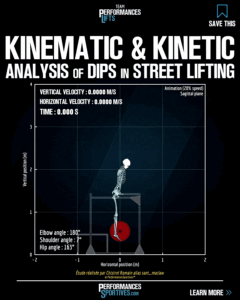
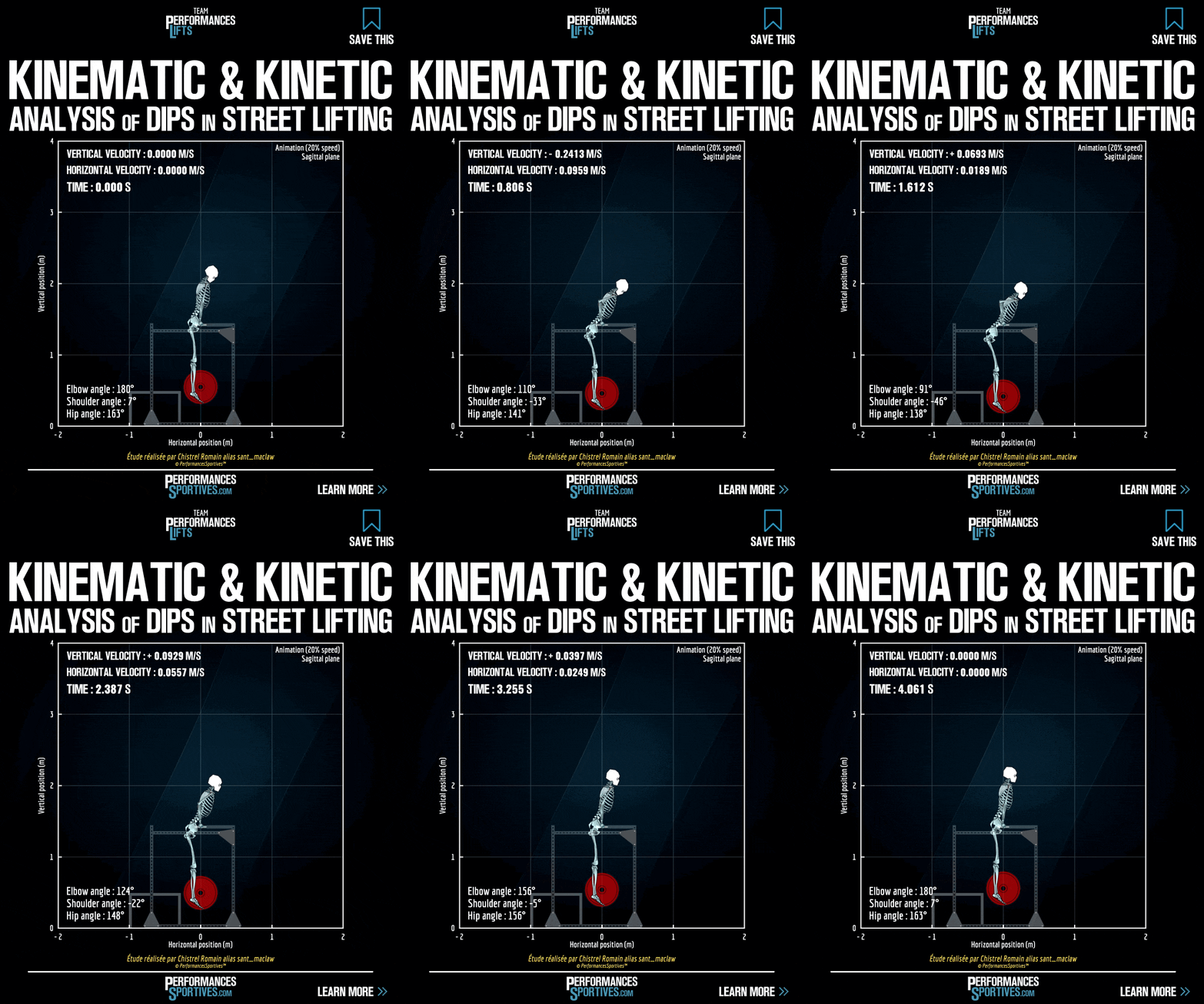
analyse cinématique et cinétique du dips en street lifting
introduction
Le dips lesté, exercice en chaîne cinétique fermée, constitue l’un des quatre mouvements réglementaires du street lifting.
Bien que sa réalisation puisse paraître simple d’un point de vue technique, des observations préliminaires indiquent une variabilité cinématique significative entre les athlètes de haut niveau. Cette variabilité suggère que, en l’absence de recommandations documentées sur ce mouvement spécifique de compétition, les athlètes ont développé des stratégies cinématiques individuelles, adaptées à leurs contraintes morphologiques et à leurs capacités neuromusculaires.
Derrière l’apparente uniformité gestuelle du dips se cache donc une diversité cinématique encore peu explorée, qui pourrait influencer à la fois la performance et le risque de blessure.
La présente étude se propose de caractériser de manière systématique ces variations cinématiques chez des athlètes de haut niveau en street lifting, en examinant notamment :Le street lifting est une discipline de force maximale dans laquelle les athlètes réalisent les mouvements suivant :
- La fréquence d’utilisation de chaque cinématique selon le sexe et la catégorie de poids ;
- La répartition angulaire exacte aux points critiques de chaque cinématique ;
- Les moments de force articulaires générés au niveau gléno-huméral et huméro-ulnaire ;
- Les trajectoires segmentaires tridimensionnelles spécifique à chaque cinématique ;
- La relation entre la morphologie des athlètes et l’adoption d’une cinématique particulière ;
- Le recrutement musculaire différentiel (EMG) des principaux stabilisateurs et moteurs spécifique à chaque cinématique ;
- L’évaluation du risque potentiel de blessure en corrélation avec la cinématique adoptée.
L’objectif de cette étude est donc de fournir une base scientifique rigoureuse pour comprendre les déterminants biomécaniques du dips, afin d’optimiser la performance et de réduire le risque de blessure, en informant à la fois la pratique des athlètes et les stratégies de coaching en street lifting compétitif.
méthodes et matériels
Analyse vidéo de la fréquence d’utilisation de chaque cinématique en compétition de street lifting :
Afin d’identifier la prévalence de chaque cinématique du dips en compétition de street lifting, ainsi que leur impact potentiel sur la performance sportive de haut niveau, une analyse vidéo systématique a été menée sur les :
- Championnats d’Europe 2024 organisés à Dessau en Allemagne ;
- Championnats du Monde 2023 organisés à Cologne en Allemagne.
- La classification des cinématiques utilisées par les athlètes d’élite ;
- La fréquence d’utilisation de chaque cinématique selon le sexe et la catégorie de poids ;
- L’association entre morphologie générale et adoption de chaque variante, sans évaluation directe de la longueur des segments osseux.
Instrumentation :
L’analyse a été réalisée à l’aide d’un logiciel d’analyse sportive (Kinovea), reconnu comme un outil fiable dans l’analyse bidimensionnelle du mouvement pour mesurer les angles articulaires, la vitesse, la distance et la trajectoire. [1, 2, 3, 4]
Variables mesurées :
- Angles articulaires (poignet, épaule, coude, hanche) aux moments clés ;
- Centre de masse (CdM) et trajectoire ;
- Estimation des moments articulaires principaux.
Validité et traitement des données :
L’ensemble des données a été traité statistiquement afin de mettre en évidence les différences entre les différentes cinématiques observées. L’analyse a également pris en compte la répartition des choix techniques des athlètes en compétition afin d’identifier les profils les plus susceptibles de tirer parti de chaque cinématique.
Expérimentation électromyographique :
Un protocole expérimental a été conduit auprès d’un athlète de référence (1,70 m, 90 kg), présentant une morphologie osseuse avec buste long, avant-bras long et bras long.
L’intervention s’est déroulée sur 8 semaines, à raison de deux séances hebdomadaires de dips. Deux conditions cinématiques distinctes ont été testées :
- Condition 1 : cinématique avec rapprochement des segments huméraux.
- Condition 2 : cinématique avec écartement des segments huméraux.
Afin de limiter les biais liés à la fatigue, une alternance des conditions a été instaurée après quatre semaines.
Évaluation électromyographique :
L’activité musculaire a été enregistrée à l’aide d’un système d’EMG de surface (K-MYO), en ciblant les principaux muscles impliqués dans le dips lesté :
- Chaîne antérieure : grand pectoral et deltoïde antérieur.
- Chaîne postérieure : grand dorsal et triceps brachial.
Le placement des électrodes a suivi les recommandations SENIAM pour l’EMG de surface (Hermens et al. 2000 ; Rodríguez-Ridao et al. 2020).
Elles ont été appliquées sur le côté dominant (droit) et fixées avec un ruban adhésif afin de limiter les artéfacts de mouvement. Les emplacements précis étaient les suivants :
- Grand pectoral, faisceau claviculaire (GPFC) : ligne médio-claviculaire, au-dessus du 2ᵉ espace intercostal.
- Grand pectoral, faisceau sterno-costal (GPFSC) : portion sternale, environ 2 cm du pli axillaire.
- Grand pectoral, faisceau abdominal (GPFA) : ligne médio-claviculaire, au-dessus du 5ᵉ espace intercostal.
- Deltoïde antérieur (DA) : 1,5 cm en avant et en dessous de l’acromion.
- Triceps brachial, chef médial (TB) : à mi-distance entre l’acromion postérieur et l’olécrâne.
- Grand dorsal (GD) : conformément aux recommandations SENIAM pour les muscles axiaux
(Glass et Armstrong 1997 ; Saeterbakken et Fimland 2013 ; Cogley et al. 2005)
Ce dispositif a permis d’obtenir une mesure fine du recrutement musculaire, des vitesses de contraction et des moments de force associés aux deux cinématiques étudiées.
résultats
Identification des cinématiques du dips en compétition de street lifting :
L’analyse vidéo des athlètes de haut niveau révèle deux stratégies cinématiques principales lors de l’exécution des dips. Les caractéristiques articulaires et segmentaires permettant de classifier ces deux cinématiques sont détaillées ci-dessous.
Cinématique du dips en street lifting avec adduction humérale volontaire (rapprochement des segments huméraux)
Observation dans le plan frontal :
- Le coude s’écarte de l’axe vertical du poignet.
- L’humérus suit une trajectoire d’adduction, se rapprochant de la ligne médiane du corps.
- Le plan moteur devient oblique, intermédiaire entre les plans sagittal et frontal.
- L’articulation de l’épaule s’aligne avec le coude, tandis que le poignet n’est plus aligné avec le coude.
Observation dans le plan sagittal :
- Inclinaison du buste d’environ 45°.
- Alignement relatif des articulations du poignet et du coude.
- L’avant-bras est proche de la verticalité, sans être strictement vertical.
Cinématique du dips en street lifting avec abduction humérale volontaire (écartement des segments huméraux)
Observation dans le plan frontal :
- Le coude reste aligné avec l’axe vertical du poignet.
- L’humérus suit une trajectoire d’abduction, s’éloignant de la ligne médiane du corps.
- L’articulation de l’épaule n’est pas alignée avec le coude, tandis que le poignet est aligné avec le coude.
Observation dans le plan sagittal :
- Inclinaison du buste d’environ 40°.
- Alignement des articulations du poignet et du coude.
- L’avant-bras est quasiment vertical, favorisant un appui plus axé.
Analyse quantitative de l’adoption des cinématiques du dips en compétition de street lifting :
Un total de 163 athlètes (99 hommes, 64 femmes) a été observé lors de 489 essais de dips, issus des derniers championnats du monde (55 hommes, 24 femmes) et d’Europe (44 hommes, 40 femmes).
L’analyse globale montre que les deux cinématiques du dips observées, à savoir, l’adduction humérale volontaire et l’abduction humérale volontaire sont utilisées de façon quasi équivalente :
- 79 athlètes (48,5 %) ont réalisé leurs essais avec adduction humérale volontaire.
- 84 athlètes (51,5 %) ont opté pour l’abduction humérale volontaire.
Chez les hommes, 47 athlètes (47,5 %) ont adopté l’adduction, tandis que 52 athlètes (52,5 %) ont utilisé l’abduction. Chez les femmes, la répartition est parfaitement équilibrée, avec 32 athlètes (50 %) pour chaque cinématique. Ces données suggèrent qu’aucune des deux stratégies cinématiques ne prédomine à l’échelle de l’élite compétitive.
Toutefois, une analyse plus fine selon la catégorie de poids révèle une tendance morpho-biomécanique significative :
- Catégories légères : prédominance de l’adduction humérale volontaire, avec une utilisation moyenne de 63 % pour les hommes (-66 et -73 kg) et 76,4 % pour les femmes (-52 et -57 kg).
- Catégories intermédiaires : distribution quasi-équilibrée entre adduction et abduction, avec 45,9 % d’utilisation pour les hommes (-80 et -87 kg) et 43,7 % pour les femmes (-63 kg).
- Catégories lourdes : la cinématique en abduction humérale volontaire devient majoritaire, avec 72 % pour les hommes (-94 et +94 kg) et 71,2 % pour les femmes (-70 et +70 kg), indépendamment du sexe.
Ces résultats mettent en évidence une relation potentielle entre la morphologie, la masse corporelle et le choix de cinématique, suggérant que les contraintes biomécaniques liées à l’adaptation du bras de levier et au contrôle du centre de masse influencent la stratégie adoptée par l’athlète.
Les tableaux récapitulatifs ci-dessous présentent la distribution détaillée de l’utilisation des deux cinématiques pour les hommes et les femmes, selon la catégorie de poids, permettant une visualisation fine des tendances observées au sein de l’élite du street lifting.
Hommes :
| Compétition Competition | Catégorie de poids Weight category | Nombre d'athlètes Number of athletes | Coudes serrés (n, %) Elbows tucked in (n, %) | Coudes ouverts (n, %) Open elbows (n, %) |
|---|---|---|---|---|
| Europe 2024 | - 66 | 8 | 6 (75%) | 2 (25%) |
| - 73 | 8 | 5 (62,5%) | 3 (37,5%) | |
| - 80 | 6 | 3 (50%) | 3 (50%) | |
| - 87 | 7 | 3 (42,9%) | 4 (57,1%) | |
| - 94 | 8 | 2 (25%) | 6 (75%) | |
| + 94 | 7 | 2 (28,6%) | 5 (71,4%) | |
| Monde 2023 | - 66 | 9 | 6 (66,7%) | 3 (33,3%) |
| - 73 | 10 | 6 (60%) | 4 (40%) | |
| - 80 | 11 | 4 (36,4%) | 7 (63,6%) | |
| - 87 | 11 | 6 (54,5%) | 5 (45,5%) | |
| - 94 | 8 | 2 (25%) | 6 (75%) | |
| + 94 | 6 | 2 (33,3%) | 4 (66,7%) |
Femmes :
| Compétition Competition | Catégorie de poids Weight category | Nombre d'athlètes Number of athletes | Coudes serrés (n, %) Elbows tucked in (n, %) | Coudes ouverts (n, %) Open elbows (n, %) |
|---|---|---|---|---|
| Europe 2024 | -52 | 8 | 6 (75%) | 2 (25%) |
| -57 | 9 | 6 (66,7%) | 3 (33,3%) | |
| -63 | 8 | 3 (37,5%) | 5 (62,5%) | |
| -70 | 8 | 2 (25%) | 6 (75%) | |
| +70 | 7 | 2 (28,6%) | 5 (71,4%) | |
| Monde 2023 | -57 | 8 | 7 (87,5%) | 1 (12,5%) |
| -63 | 6 | 3 (50%) | 3 (50%) | |
| -70 | 7 | 2 (28,6%) | 5 (71,4%) | |
| +70 | 3 | 1 (33,3%) | 2 (66,7%) |
Conséquences biomécaniques de la :
Cinématique du dips en street lifting avec adduction humérale volontaire (rapprochement des segments huméraux)
- Réalignement du vecteur de force : Au point critique du mouvement, plus communément appelé « sticking point », un réalignement spontané des coudes vers une légère abduction s’observe fréquemment. Ce phénomène traduit une stratégie motrice visant à réaligner le vecteur de force global dans une orientation quasi verticale, optimisant ainsi le transfert mécanique à travers la chaîne cinétique (Schick et al., 2010).
L’objectif est d’aligner la résultante musculaire pectoro-tricipitale avec la ligne d’action de la charge, améliorant la transmission du couple articulaire du coude vers l’épaule. - Augmentation du bras de levier : L’adduction humérale rapproche les coudes de la ligne médiale du corps, éloignant l’axe gléno-huméral de la ligne d’action du poids. Cette configuration accroît le moment de force externe au niveau de l’épaule, augmentant la demande de force interne compensatoire.
En conséquence, le grand pectoral (faisceau sternal) et les stabilisateurs scapulaires (trapèze moyen, rhomboïdes, grand dorsal) sont davantage sollicités pour contrôler le bras de levier prolongé.
Cela favorise la production de force horizontale, mais au prix d’un stress articulaire et neuromusculaire supérieur. - Projection antérieure du Centre de Masse (CdM) : L’adduction s’accompagne d’une translation antérieure du CdM, suivant une trajectoire curviligne et induisant une inclinaison du tronc supérieure, d’environ 45°. Ce déplacement vers l’avant accroît les contraintes excentriques sur les structures antérieures de l’épaule, tout en favorisant une meilleure production de force horizontale (Chiu et al., 2010).
La résultante musculaire devient alors légèrement oblique, combinant un vecteur vertical et un vecteur horizontal, configuration optimale pour le franchissement du point de blocage. - Réduction du moment d’inertie : Dans le plan frontal, la convergence des coudes crée une structure corporelle plus groupée. En rapprochant les segments supérieurs de l’axe sagittal, l’athlète réduit le moment d’inertie frontal, limitant les oscillations latérales et stabilisant la trajectoire du Centre de Masse (Levin et al., 2005 ; Cogley et al., 2005).
Cette réduction du moment d’inertie diminue le besoin de corrections posturales dynamiques, améliorant la stabilité mécanique perçue et la précision neuromusculaire dans la phase ascendante. - Stabilisation scapulaire : La posture inclinée induite par l’adduction nécessite une forte co-contraction scapulaire. Les muscles trapèze moyen et inférieur, rhomboïdes et grand dorsal agissent en synergie pour maintenir une stabilité tridimensionnelle de la scapula, limitant la rotation interne humérale et contrôlant la convergence médiale excessive.
Ce verrouillage dynamique compense la perte de stabilité passive liée à l’augmentation du bras de levier et assure une distribution homogène des forces internes sur les structures capsulaires gléno-humérales. Les forces de cisaillement antérieures y sont plus importantes, exigeant une tolérance articulaire élevée et un engagement stabilisateur intense. - Vecteur de force : Dans le plan frontal, le rapprochement des bras aligne mieux le vecteur de force avec la ligne médiale du corps, créant un couloir de force quasi vertical à travers le coude, l’épaule et le tronc.
Cette configuration permet de transférer efficacement la force générée par les pectoraux et triceps vers le tronc (Escamilla, 2001 ; Cogley et al., 2005).
Synthèse :
L’adduction humérale volontaire dans le dips constitue un ajustement biomécanique complexe, combinant un bras de levier accru, une réduction du moment d’inertie frontal et une co-contraction stabilisatrice marquée.
Cette configuration optimise la production de force horizontale et le contrôle postural, mais au prix d’une élévation significative des contraintes articulaires et d’une demande neuromusculaire accrue.
Conséquences biomécaniques de la :
Cinématique du dips en street lifting avec abduction humérale volontaire (écartement des segments huméraux)
- Alignement articulaire optimisé : L’abduction humérale volontaire maintient le coude aligné avec l’axe vertical du poignet, assurant ainsi une transmission quasi linéaire du vecteur de force depuis le point d’application jusqu’à l’articulation gléno-humérale. Cette disposition réduit les forces de cisaillement antérieures au niveau de la capsule articulaire tout en augmentant la composante compressive, favorable à la stabilité mécanique (Escamilla, 2001). Le mouvement devient davantage axial, diminuant les contraintes de rotation interne de l’humérus et améliore la congruence articulaire scapulo-humérale.
- Réduction du bras de levier : L’écartement latéral des coudes diminue la distance perpendiculaire entre la ligne d’action de la force gravitationnelle et l’axe de rotation gléno-huméral, entraînant une réduction du moment de force externe.
Cette configuration mécanique allège la charge articulaire sur l’épaule, mais déplace une part plus importante du travail moteur vers le triceps brachial, qui devient le principal contributeur à la phase concentrique. Ainsi, la contrainte mécanique est plus axiale que tangentielle, réduisant la sollicitation des stabilisateurs scapulaires. - Centre de Masse (CdM) et trajectoire verticale : Avec l’abduction, la projection du CdM reste confinée dans un couloir quasi vertical. Cette stabilité directionnelle réduit les moments de flexion du tronc et les oscillations latérales, ce qui améliore le contrôle postural global (Saeterbakken et al., 2017). Le tronc plus vertical et la réduction du déplacement antéro-postérieur du CdM permettent une meilleure conservation de l’énergie mécanique et une moindre dissipation dans le plan sagittal.
- Profil musculaire : L’orientation des bras en abduction déplace le recrutement musculaire vers une prédominance du triceps brachial et du faisceau claviculaire du grand pectoral. Le triceps agit dans une trajectoire quasi linéaire, avec un angle de poussée proche de 90° par rapport à l’avant-bras, ce qui maximise le rendement mécanique de l’extension du coude. Le grand pectoral claviculaire, quant à lui, intervient davantage dans la coaptation antérieure de la tête humérale. Cette répartition modifie le couple de force intermusculaire, rendant le mouvement plus segmentaire.
- Stabilité et contraintes locales : Cette cinématique est souvent associée à une sensation d’instabilité accrue. En effet, le coude étant plus éloigné de la ligne médiale, l’articulation devient mécaniquement plus instable : la charge s’applique avec un léger moment d’abduction, sollicitant les structures passives (ligament collatéral ulnaire) et imposant un travail stabilisateur accru au chef latéral du triceps et au deltoïde antérieur.
- Vecteur de force et inertie latérale : Dans le plan frontal, l’éloignement des bras de la ligne médiale déplace latéralement la masse segmentaire des membres supérieurs. Cette répartition augmente le moment d’inertie latéral et le bras de levier frontal, induisant une instabilité accrue dans le plan frontal. Pour maintenir l’alignement vertical du Centre de Masse, le système neuromusculaire doit compenser par une co-contraction renforcée du tronc, des muscles scapulaires et des fixateurs de la ceinture scapulaire (trapèze moyen, dentelé antérieur).
Synthèse :
L’abduction humérale volontaire dans le dips représente une configuration axiale et économiquement stable, favorisant la transmission linéaire des forces et réduisant les contraintes de cisaillement sur l’épaule.
Analyse des résultats électromyographique des cinématiques du dips en street lifting :
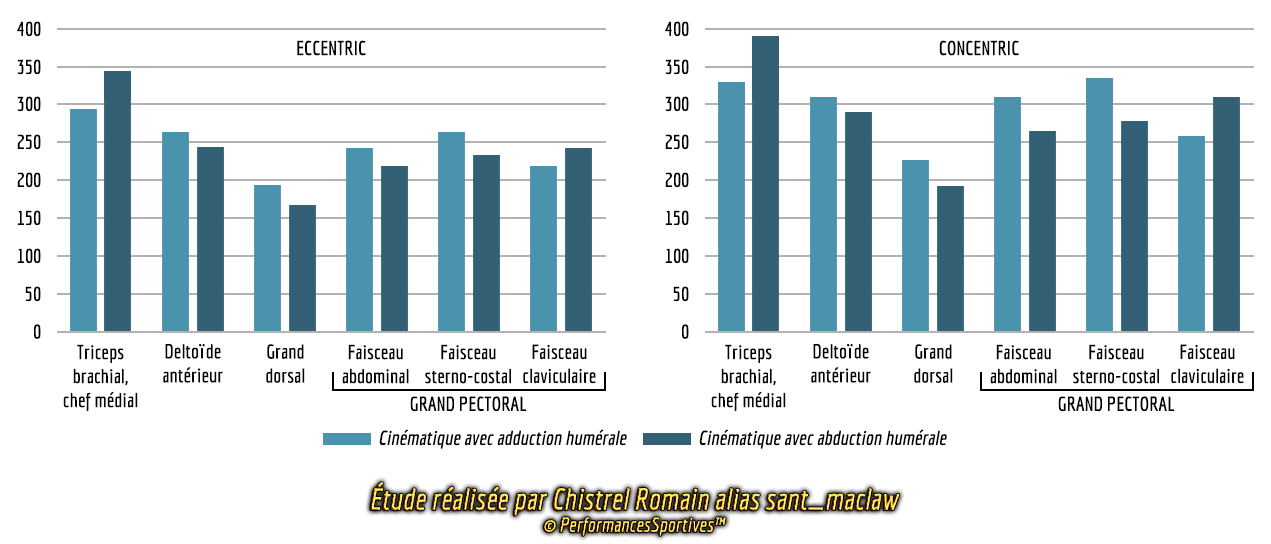
Les résultats issus de l’analyse électromyographique corroborent les hypothèses préalablement établies à partir de l’examen biomécanique des deux cinématiques du dips (abduction humérale volontaire contre adduction humérale volontaire).
Concernant le grand pectoral, une différenciation marquée est observée entre les portions claviculaire, sternale et abdominale du grand pectoral.
- Dans la cinématique avec adduction humérale volontaire, l’activité du faisceau sterno-costal dépasse celle du faisceau claviculaire de 29,4 %, et celle du faisceau abdominal de 8,2 %. Le faisceau abdominal, quant à lui, présente une activité 19,6 % supérieure à celle du faisceau claviculaire.
→ Cette distribution indique une prédominance nette de la portion sternale, associée à un angle huméral plus fermé et une inclinaison du tronc favorisant la convergence des bras. - À l’inverse, dans la cinématique avec abduction humérale volontaire, le faisceau claviculaire présente une activation 10,9 % plus élevée que la portion sterno-costale et 17,3 % plus élevée que la portion abdominale.
→ Ce pattern traduit une orientation plus verticale du mouvement et une participation accrue de la portion supérieure du grand pectoral, cohérente avec un angle huméral ouvert et une trajectoire du centre de masse plus verticale.
En résumé, l’adduction humérale volontaire induit une répartition non homogène des faisceaux du grand pectoral, centrée sur le faisceau sterno-costal, tandis que l’abduction humérale volontaire génère une sollicitation plus équilibrée des différents faisceaux du grand pectoral, mais orientée vers le faisceau claviculaire.
L’analyse du triceps brachial révèle une activité électromyographique supérieure dans la cinématique avec abduction humérale volontaire, traduisant une extension du coude plus marquée et un engagement mécanique optimisé de la chaîne postérieure du bras. Cette configuration réduit simultanément la mise en tension antérieure de l’épaule, limitant les contraintes sur le complexe gléno-huméral et sur les muscles de la chaîne antérieure.
En ce qui concerne l’activité du deltoïde antérieur est significativement accrue dans la cinématique avec adduction humérale volontaire. Cette élévation résulte d’une exigence plus importante en stabilisation antérieure, liée à l’inclinaison du tronc et au rapprochement des segments huméraux. Ce comportement est cohérent avec les travaux de Saeterbakken & Fimland (2013), qui ont montré une augmentation similaire de l’activité du deltoïde antérieur lors de mouvements de poussée impliquant un bras de levier antérieur accru.
Enfin, le grand dorsal présente une implication plus marquée dans la cinématique avec adduction humérale volontaire, vraisemblablement en raison de son rôle synergique dans la coaptation gléno-humérale et la stabilisation postérieure du complexe scapulo-thoracique. Cette contribution posturale soutient la stabilité de l’articulation en phase descendante du mouvement.
En synthèse, la cinématique avec adduction humérale volontaire se caractérise par une prédominance d’activation de la portion sternale du grand pectoral, du deltoïde antérieur et du grand dorsal, tandis que la cinématique avec abduction humérale volontaire mobilise préférentiellement la portion claviculaire du grand pectoral et le triceps brachial.
Ces données confirment ainsi que la cinématique du dips en street lifting module profondément la distribution de l’effort entre la chaîne antérieure et la chaîne postérieure. L’électromyographie révèle ainsi un transfert de l’activité musculaire en fonction de l’orientation humérale, validant la relation entre stratégie cinématique et spécialisation neuromusculaire.
Analyse par électromyographie de l’utilisation des cinématiques du dips en street lifting :
L’électromyographie a confirmé les observations issues de l’analyse cinématique, révélant des profils d’activation musculaire distincts selon la stratégie adoptée lors du dips en street lifting.
On observe ainsi :
- une sollicitation accrue des portions sternale et abdominale du grand pectoral, du deltoïde antérieur et du grand dorsal lors de la cinématique avec adduction humérale volontaire,
- une activation supérieure du faisceau claviculaire du grand pectoral ainsi que du triceps brachial lors de la cinématique avec abduction humérale volontaire.
Ces contrastes d’activation traduisent une redistribution des efforts entre la chaîne antérieure et postérieure, modulée par l’orientation humérale et la trajectoire du centre de masse.
Ils confirment que le choix de la cinématique au dips influence directement la spécialisation neuromusculaire, orientant le recrutement vers la puissance horizontale ou la force verticale, selon les exigences mécaniques du geste.
discussion
Analyse électromyographique croisée avec la littérature scientifique :
Nos résultats confirment que la cinématique du dips module fortement la répartition de l’activation musculaire, en accord avec les observations issues de la littérature scientifique.
Concernant le grand pectoral, l’abduction humérale volontaire favorise la portion claviculaire, tandis que l’adduction humérale volontaire accentue le recrutement de la portion sternale. Ces résultats rejoignent les travaux de Roy (2021), Rodríguez-Ridao et al. (2020), López-Vivancos (2023), Muyor et al. (2019), Glass & Armstrong (1997), ainsi que Trebs et al. (2010), qui démontrent que l’inclinaison du banc modifie linéairement la distribution EMG entre les portions du grand pectoral : une inclinaison du buste de +30° à +45° (correspondant au différentiel entre l’angle du buste en abduction humérale et l’angle du buste en adduction humérale) augmente l’activité de la portion claviculaire de 23 à 30 %, tandis que l’activité sternale décroît proportionnellement. Ces ajustements confirment que les angles articulaires huméraux influencent directement la contribution segmentaire des faisceaux pectoraux, aussi bien en bench press qu’en dips.
Pour le triceps brachial, nos résultats montrent une activation accrue lors de la cinématique avec abduction humérale volontaire. Ces observations concordent avec les conclusions de McKenzie et al. (2022), qui ont montré que la variation du support (barres parallèles vs anneaux) modifie significativement le recrutement du triceps brachial, l’instabilité amplifiant l’activité EMG moyenne (RMS). Cette majoration est comparable à celle observée par Lehman (2005) au bench press instable, où l’augmentation de l’instabilité augmente la co-activation tricipitale et scapulaire. Ainsi, l’abduction humérale volontaire, en générant une trajectoire plus verticale mais latéralement déstabilisante, semble accentuer la dépendance au triceps comme moteur principal.
Concernant le deltoïde antérieur, nos observations s’alignent avec les travaux de Calatayud et al. (2015), Freeman et al. (2006) et Rodríguez-Ridao et al. (2020), qui ont démontré que l’élévation humérale dans le plan sagittal accroît la sollicitation de ce muscle lors des mouvements de poussée en chaîne cinétique fermée (pompes, bench press, dips). Ce phénomène s’explique par une majoration du bras de levier antérieur de l’humérus et un couple de flexion accru à l’épaule.
Enfin, le grand dorsal agit principalement comme stabilisateur, particulièrement en adduction humérale volontaire. Son activation reste faible au bench press (Barnett et al., 1995 ; Saeterbakken et al., 2017 ; Glass & Armstrong, 1997), mais son rôle devient significatif au dips, où il contribue à la coaptation gléno-humérale, au contrôle de la translation antérieure de la tête humérale, et à la stabilisation de la scapula en fin d’amplitude (McKenzie et al., 2022).
En établissant un lien entre nos résultats et les travaux précédents, nous pouvons affirmer que :
- L’abduction humérale volontaire privilégie le couple grand pectoral claviculaire – triceps brachial, dans un contexte plus instable et axialement contraint, favorisant la transmission verticale de la force.
- L’adduction humérale volontaire, au contraire, renforce le recrutement sternocostal, deltoïdien antérieur et dorsal, traduisant une stratégie horizontale et stabilisatrice, mais mécaniquement plus contraignante.
Ces deux schémas activatoires traduisent des stratégies neuromusculaires distinctes, confirmant la capacité du dips à reproduire des patterns de recrutement segmentaire similaires aux angles d’activation pectorale décrits dans la littérature EMG contemporaine.
Analyse croisée avec la littérature scientifique anato-morphologique :
L’orientation cinématique adoptée par les athlètes de street lifting, notamment la préférence pour l’adduction ou l’abduction humérale volontaire, semble résulter d’une interaction complexe entre des facteurs biomécaniques, physiologiques et morphologiques.
Bien que les études spécifiques à cette discipline demeurent rares, plusieurs travaux en biomécanique de la poussée et physiologie musculaire permettent d’en éclairer les déterminants.
Morphologie segmentaire et variabilité interindividuelle :
L’analyse n’a pas permis d’établir de lien direct entre la longueur des segments des membres supérieurs (bras courts vs longs) et la cinématique utilisée. Des athlètes aux morphologies opposées (bras courts ou longs) ont été observés dans les deux cinématiques, ce qui suggère que la morphologie osseuse segmentaire n’est pas un facteur discriminant majeur.
Cependant, la répartition morphologique selon les catégories de poids révèle une tendance nette :
- Les athlètes légers privilégient systématiquement l’adduction humérale volontaire, indépendamment du sexe.
- Deux hypothèses biomécaniques soutiennent cette observation :
- 1. Morphologie segmentaire : des segments plus courts facilitent la mécanique convergente des bras et le rapprochement huméral sans perte de stabilité.
- 2. Composition corporelle : une masse corporelle moindre réduit les contraintes gravitationnelles et excentriques sur l’épaule, permettant une trajectoire plus horizontale et une inclinaison du tronc plus marquée, sans compromettre la stabilité.
Ces observations rejoignent les principes décrits dans les exercices de poussée où la morphologie segmentaire et la masse corporelle modulent la cinématique du COM et la répartition du travail musculaire (Escamilla, 2001 ; Chiu et al., 2010 ; Saeterbakken et al., 2017).
Influence de la longueur du tronc et de l’inclinaison du buste :
L’analyse morphologique détaillée a permis d’identifier une distinction plus subtile liée à la proportion tronc/taille totale :
- Les athlètes adoptant une cinématique avec abduction humérale présentent généralement un buste “normal à long”, représentant en moyenne ≈ 55 % de la taille totale.
- Ceux adoptant une cinématique avec adduction humérale ont un buste plus court, représentant environ ≈ 50 % de la taille totale.
Cette différence semble refléter une adaptation biomécanique fonctionnelle :
- Un buste long favorise une cinématique plus verticale et plus stable, réduisant le besoin d’inclinaison excessive du tronc.
- Un buste court, au contraire, facilite une inclinaison plus prononcée (≈ 45° contre ≈ 40°), optimisant le recrutement sternocostal du grand pectoral et la production de force horizontale (Trebs et al., 2010 ; Rodríguez-Ridao et al., 2020).
Ainsi, les athlètes au buste long adoptent plus aisément une abduction humérale volontaire, limitant l’inclinaison du tronc et stabilisant la projection du COM dans un couloir quasi-vertical, configuration plus efficiente pour les gabarits lourds.
Conclusion :
La préférence pour l’adduction ou l’abduction humérale volontaire en street lifting résulte d’une interaction multifactorielle entre la morphologie corporelle, le recrutement musculaire, la stabilité articulaire et les contraintes mécaniques.
Les athlètes légers, à morphologie compacte et bras courts, privilégient l’adduction pour optimiser le transfert de force et le contrôle postural, tandis que les athlètes lourds, au tronc plus long et segments étendus, adoptent l’abduction, qui offre une meilleure stabilité scapulaire et limite les contraintes excentriques sur l’épaule.
Le risque de blessures sur le dips en street lifting :
Le dips est reconnu comme un des exercices les plus à risque pour l’articulation gléno-humérale, notamment en raison de la position extrême d’extension et d’abduction forcée de l’épaule (Schoenfeld, 2010 ; Struyf et al., 2014). Ces positions combinent contraintes articulaires, étirement musculaire maximal et compression sous-acromiale, exposant plusieurs structures antérieures à un stress mécanique élevé.
Risques articulaires et musculaires liés aux différentes cinématiques :
Les amplitudes maximales atteintes au dips accroissent la tension sur la capsule antérieure et sur le tendon du chef long du biceps (McClure et al., 2001 ; Struyf et al., 2014).
La combinaison abduction + charge externe accentue la contrainte sur ces structures, augmentant le risque de tendinopathie, de conflit sous-acromial et de douleurs antérieures (Yang et al., 2023 ; Phornphutkul et al., 2021).
Cette contrainte est d’autant plus marquée que la réduction de l’espace sous-acromial est amplifiée en extension et abduction (Lawrence et al., 2014 ; Diplock et al., 2023 ; Ludewig & Braman, 2011). Une cinématique scapulaire insuffisante, ou une élévation exagérée de la scapula, peut perturber la coaptation gléno-humérale et fragiliser le tendon du sus-épineux (Boettcher et al., 2010 ; Castelein et al., 2016).
Influence de l’adduction humérale volontaire sur le risque de blessure :
Surcharge des stabilisateurs scapulaires (trapèzes moyen et inférieur, rhomboïdes, grand dorsal), soumis à une co-contraction intense pour maintenir la stabilité scapulo-thoracique (Escamilla, 2001 ; Chiu et al., 2010).
Surmenage musculaire du faisceau sterno-costal et du deltoïde antérieur lié à la projection antérieure du tronc et à l’allongement du bras de levier, favorisant micro-lésions et fatigue chronique.
➡️ Cette cinématique augmente la contrainte antérieure et expose à des tendinopathies du grand pectoral ou à une fatigue scapulaire répétée.
Influence de l’abduction humérale volontaire sur le risque de blessure :
Surcharge du tendon du chef long du biceps, en position de tension maximale dans la gouttière bicipitale (Phornphutkul et al., 2021 ; Govender et al., 2022 ; Diplock et al., 2023).
Risque de surcharge du faisceau claviculaire du grand pectoral, souvent activé avec retard à ces angles d’abduction, augmentant les contraintes mécaniques locales (Gentil et al., 2017 ; Saeterbakken et al., 2017 ; Amaro et al., 2021).
➡️ Cette cinématique, accroît les risques de tendinopathie du long biceps et les risques de claquages et déchirures du faisceau claviculaire du grand pectoral.
Application pratique pour la prévention :
La variabilité cinématique entre athlètes constitue un levier clé pour concilier performance et sécurité articulaire. Adapter la cinématique à la morphologie, à la mobilité scapulo-humérale et à la tolérance articulaire permet de :
- Maximiser le recrutement musculaire ciblé selon l’objectif (faisceau claviculaire vs sterno-costal) ;
- Réduire la surcharge des structures antérieures à risque (biceps, capsule, pectoral) ;
- Favoriser la coaptation scapulo-humérale dynamique via un contrôle progressif de l’amplitude et de l’angle d’abduction (McClure et al., 2001 ; Escamilla, 2001 ; Castelein, 2016 ; Yang et al., 2023).
➡️ En pratique, une évaluation individuelle suivie d’une progression adaptée en charge et en amplitude s’impose dans la sélection d’une cinématique personnalisée selon la morphologie, le niveau d’entraînement et la tolérance mécanique de chaque athlète.
Application à l’entraînement selon la cinématique du dips :
L’analyse combinée des cinématiques, de l’activation musculaire et des contraintes biomécaniques permet de définir des stratégies d’entraînement individualisées. La personnalisation contribue à maximiser le recrutement musculaire tout en minimisant les contraintes articulaires et les risques de pathologie.
Cinématique du dips en street lifting avec adduction humérale volontaire (rapprochement des segments huméraux)
- Objectifs d’entraînement :
- Développer la force horizontale et la puissance de poussée dans le plan sagittal.
- Renforcer la co-contraction scapulaire et la stabilité dynamique du tronc.
- Optimiser le recrutement du faisceau sterno-costal du grand pectoral tout en limitant le stress mécanique sur le faisceau antérieur du deltoïde.
- Exercices recommandés :
- Dips sur anneaux, coudes rentrés : Favorisent la co-contraction des stabilisateurs scapulaires et le contrôle du centre de masse (COM).
- Développé couché prise serrée : Accentue le recrutement du triceps et du faisceau sternal dans un schéma convergent.
- Pendlay row coudes rentrés : Renforce le grand dorsal et les fixateurs scapulaires, équilibrant la chaîne postérieure.
- Face pulls : Ciblent trapèzes moyens et inférieurs, rhomboïdes et rotateurs externes pour améliorer la coaptation scapulo-humérale.
- Consignes de sécurité :
- Maintenir une amplitude contrôlée afin de limiter la surcharge sur les stabilisateurs scapulaires et la capsule antérieure.
- Augmenter la charge progressivement tout en assurant le contrôle du COM pour éviter les oscillations.
- Surveiller les contractures potentielles du faisceau sterno-costal et des stabilisateurs scapulaires, en raison de la forte co-contraction exigée (Chiu et al., 2010 ; Escamilla, 2001).
Synthèse :
Cette cinématique favorise un travail de poussée horizontale et la stabilité scapulaire. L’accent mis sur la co-contraction et le contrôle postural permet de développer la force du faisceau sterno-costal et du triceps, tout en préservant l’articulation antérieure de l’épaule grâce à un équilibre avec les muscles de la chaîne postérieure.
Cinématique du dips en street lifting avec abduction humérale volontaire (écartement des segments huméraux)
- Objectifs d’entraînement :
- Développer la force verticale et la capacité de stabilisation dynamique dans des conditions d’instabilité.
- Renforcer le faisceau claviculaire du grand pectoral et le triceps en charge excentrique contrôlée.
- Optimiser la transmission de force axiale tout en prévenant la surcharge du tendon du chef long du biceps.
- Exercices recommandés :
- Développé couché incliné (30-45°) : Cible le faisceau claviculaire du grand pectoral et prépare l’épaule aux angles d’abduction élevés (Cogley et al., 2005).
- Curl incliné avec haltères : Renforce spécifiquement le tendon du chef long du biceps en reproduisant son excursion maximale dans la gouttière bicipitale, réduisant ainsi le risque de tendinopathie dans une cinématique proche de l’extension des épaules lors du dips (Phornphutkul et al., 2021).
- Bent over row coudes ouverts : Équilibre la chaîne postérieure en renforçant les fixateurs scapulaires, dans une cinématique de buste proche de celle attendue lors de l’abduction humérale volontaire au dips.
- L-fly à la poulie : Renforce le contrôle scapulo-huméral et les rotateurs externes, afin de prévenir les translations humérales et limiter le stress sur le tendon du chef long du biceps (Escamilla, 2001 ; Phornphutkul et al., 2021).
- Consignes de sécurité :
- Limiter la profondeur du dips si des douleurs antérieures apparaissent, afin de réduire le stress sur le tendon du chef long du biceps et la capsule gléno-humérale (Schoenfeld, 2010).
- Surveiller particulièrement le faisceau claviculaire, souvent en retard par rapport aux autres faisceaux, et exposé à la surcharge mécanique (Gentil et al., 2017 ; Amaro et al., 2021 ; Saeterbakken et al., 2017).
- Mettre l’accent sur la stabilisation scapulaire et le contrôle du Centre de Masse, pour réduire les moments de force excentrés et optimiser la transmission des vecteurs de force.
Synthèse :
Cette cinématique cible principalement la force verticale et la stabilisation dynamique. L’intégration d’exercices spécifiques pour le tendon du long biceps, le faisceau claviculaire et les stabilisateurs scapulaires permet de prévenir les tendinopathies et douleurs antérieures, tout en développant efficacement la puissance musculaire et la stabilité de l’épaule.
Les résultats de cette étude confirment que la cinématique adoptée lors du dips modifie significativement les schémas d’activation musculaire, la distribution des contraintes articulaires et le positionnement du Centre de Masse (CdM).
L’identification de la cinématique dominante permet une programmation sur mesure selon trois axes :
- 1. Orientation de la force produite
→ Adduction : vecteurs horizontaux, travail convergent.
→ Abduction : vecteurs verticaux, travail axial. - 2. Prévention des surcharges spécifiques
→ Adduction : vigilance sur la co-contraction scapulaire excessive.
→ Abduction : vigilance sur le tendon du long biceps et la coiffe antérieure. - 3. Optimisation du transfert inter-exercices
→ Choisir les variantes en cohérence avec la cinématique dominante et les besoins compétitifs.
➡️ Ainsi, la lecture biomécanique du dips devient un outil d’entraînement en offrant une double finalité : améliorer la performance spécifique tout en renforçant la résilience articulaire.
Limites et perspectives de l’étude :
Malgré la rigueur méthodologique, plusieurs limites doivent être prises en considération :
- Échantillon restreint : L’étude EMG repose sur un cas unique, limitant la généralisation des observations à l’ensemble des athlètes de street lifting.
- Variabilité morphologique non intégrée : Des paramètres tels que la largeur des clavicules, la mobilité scapulaire et l’antéversion pelvienne n’ont pas été inclus, alors qu’ils influencent directement la cinématique et la répartition des contraintes.
- Accessoires non standardisés : L’utilisation variable d’équipements de soutien (coudières, bandes de poignets) a pu modifier la mécanique articulaire et l’activation musculaire.
- Absence de suivi longitudinal : L’étude, limitée à une observation instantanée, ne permet pas d’évaluer l’incidence à long terme de chaque cinématique sur la prévention des blessures et l’adaptation neuromusculaire.
Axes de recherche futurs :
Afin de prolonger ces travaux, plusieurs axes de recherche et d’application peuvent être envisagés :
- Élargissement de l’échantillon : Inclure un panel plus large d’athlètes, de morphotypes variés et des deux sexes, afin de corréler les caractéristiques morphologiques avec le choix de cinématique optimale.
- Suivi longitudinal : Mettre en place une observation sur plusieurs mois pour mesurer l’impact des deux cinématiques sur la performance, la tolérance articulaire et la prévalence des tendinopathies.
- Analyses instrumentales avancées : Employer des outils comme l’EMG haute résolution, la cinématique 3D, et l’imagerie médicale (IRM, échographie tendineuse) pour quantifier les contraintes sur le tendon du chef long du biceps et les faisceaux du grand pectoral.
- Approche prophylactique et périodisation : Explorer la complémentarité des deux cinématiques dans une logique de périodisation raisonnée, alternant les angles de travail afin de maximiser la performance tout en réduisant les risques pathologiques.
🇬🇧 english version 🇬🇧
kinematic and kinetic analysis of dips in street lifting
introduction
The weighted dip, a closed kinetic chain exercise, is one of the four regulated movements in competitive street lifting. Although its execution may appear technically straightforward, preliminary observations indicate substantial kinematic variability among elite-level athletes. This variability suggests that, in the absence of documented recommendations for this specific competitive movement, athletes have developed individual kinematic strategies adapted to their morphological characteristics and neuromuscular capabilities.
Thus, behind the apparent uniformity of the dip movement lies a largely unexplored diversity of kinematic strategies, which may influence both performance and injury risk.
The present study aims to systematically characterize these kinematic variations in elite-level street lifting athletes, with particular focus on:
- The frequency of use of each kinematic strategy according to sex and weight category ;
- The precise angular distribution at key points of the movement for each kinematic strategy ;
- The joint moments generated at the glenohumeral and humeroulnar joints ;
- The three-dimensional segmental trajectories specific to each kinematic strategy ;
- The relationship between athletes’ morphology and the adoption of a particular kinematic strategy ;
- Differential muscle activation, assessed using EMG, of the main stabilizers and prime movers associated with each kinematic strategy ;
- The assessment of potential injury risk in relation to the kinematic strategy adopted.
The overall aim of this study is therefore to provide a rigorous scientific framework for understanding the biomechanical determinants of the dip, with the broader objective of optimizing performance while reducing injury risk. By doing so, this work seeks to inform both athlete practice and coaching strategies in competitive street lifting.
methods and materials
Video Analysis of the Frequency of Use of Each Kinematic Strategy in Competitive Street Lifting :
To determine the prevalence of each dip kinematic strategy in competitive street lifting, as well as its potential implications for high-level athletic performance, a systematic video analysis was conducted using footage from :
- The 2024 European Championships, held in Dessau, Germany ;
- The 2023 World Championships, held in Cologne, Germany.
- Classification of the kinematic strategies used by elite athletes ;
- Frequency of use of each kinematic strategy according to sex and weight category ;
- Association between general body morphology and the adoption of each variant, without direct assessment of individual bone segment lengths.
Instrumentation :
The analysis was performed using Kinovea, a sports motion analysis software recognized as a reliable tool for two-dimensional movement analysis, including the measurement of joint angles, velocity, distance, and movement trajectories [1, 2, 3, 4].
Measured Variables :
- Joint angles (wrist, shoulder, elbow, and hip) at key points of the movement ;
- Centre of mass (CoM) and its trajectory ;
- Estimated joint moments at the main joints involved in the movement.
Data Processing :
All collected data were statistically analyzed to identify differences between the various kinematic strategies observed.
The analysis also considered the distribution of technical choices among athletes during competition in order to identify the athlete profiles most likely to benefit from each kinematic strategy.
Electromyographic Experiment :
An experimental protocol was conducted on a reference athlete (1.70 m, 90 kg) with a long-torso, long-forearm, and long-upper-arm skeletal morphology.
The intervention was conducted over 8 weeks, with two dip sessions per week. Two distinct kinematic conditions were investigated :
- Condition 1 : kinematics characterized by medial displacement of the humeral segments.
- Condition 2 : kinematics characterized by lateral displacement of the humeral segments.
To minimize potential confounding effects related to fatigue and adaptation, the two conditions were alternated after four weeks.
Electromyographic Assessment :
Muscle activity was recorded using a surface electromyography (sEMG) system (K-MYO), targeting the main muscles involved in the weighted dip :
- Anterior muscle chain : pectoralis major and anterior deltoid.
- Posterior muscle chain : latissimus dorsi and triceps brachii.
Electrode placement followed the SENIAM recommendations for surface EMG (Hermens et al., 2000; Rodríguez-Ridao et al., 2020).
Electrodes were placed on the dominant side (right) and secured with adhesive tape to minimize movement artefacts. The precise electrode locations were as follows :
- Pectoralis major, clavicular head (PM-C) : along the mid-clavicular line, above the second intercostal space.
- Pectoralis major, sternocostal head (PM-SC) : over the sternal portion, approximately 2 cm lateral to the axillary fold.
- Pectoralis major, abdominal head (PM-A) : along the mid-clavicular line, above the fifth intercostal space.
- Anterior deltoid (AD) : 1.5 cm anterior and inferior to the acromion.
- Triceps brachii, medial head (TB) : midway between the posterior aspect of the acromion and the olecranon.
- Latissimus dorsi (LD) : in accordance with SENIAM recommendations for axial muscles.
(Glass & Armstrong, 1997; Saeterbakken & Fimland, 2013; Cogley et al., 2005)
This experimental setup enabled the characterization of muscle activation, contraction velocity, and joint moments of force associated with the two kinematic conditions investigated.
results
Identification of Dip Kinematic Strategies in Competitive Street Lifting :
Video analysis of elite-level athletes reveals two main kinematic strategies during dip execution. The joint and segmental characteristics used to distinguish between these two strategies are described below.
Kinematic Strategy Characterized by Voluntary Humeral Adduction (Medial Displacement of the Humeri)
Frontal plane observations :
- The elbow deviates from the vertical axis of the wrist.
- The humerus follows an adduction trajectory, moving towards the body’s midline.
- The movement plane becomes oblique, lying between the sagittal and frontal planes.
- The shoulder joint aligns with the elbow, while the wrist is no longer aligned with the elbow.
Sagittal plane observations :
- Trunk inclination of approximately 45°.
- Relative alignment of the wrist and elbow joints.
- The forearm remains close to vertical, without being strictly vertical.
Kinematic Strategy Characterized by Voluntary Humeral Abduction (Lateral Displacement of the Humeri)
Frontal plane observations :
- The elbow remains aligned with the vertical axis of the wrist.
The humerus follows an abduction trajectory, moving away from the body’s midline.
The shoulder joint is not aligned with the elbow, while the wrist remains aligned with the elbow.
Sagittal plane observations :
- Trunk inclination of approximately 40°.
Alignment of the wrist and elbow joints.
The forearm remains nearly vertical, promoting a more vertically oriented support position.
Quantitative Analysis of Dip Kinematic Strategy Adoption in Competitive Street Lifting :
A total of 163 athletes (99 men and 64 women) were observed across 489 dip attempts recorded at the most recent World Championships (55 men and 24 women) and European Championships (44 men and 40 women).
The overall analysis revealed that the two observed dip kinematic strategies, namely humeral adduction and humeral abduction, were used with almost equal frequency :
- 79 athletes (48.5%) performed their attempts using a humeral adduction strategy.
- 84 athletes (51.5%) adopted a humeral abduction strategy.
Among men, 47 athletes (47.5%) adopted the adduction strategy, whereas 52 (52.5%) used the abduction strategy. Among women, the distribution was perfectly balanced, with 32 athletes (50%) using each strategy. These findings suggest that neither kinematic strategy clearly predominates at the elite competitive level.
However, a more detailed analysis by weight category revealed a potential morphobiomechanical trend :
- Lighter weight categories : humeral adduction was predominant, with a mean prevalence of 63% among men (−66 and −73 kg) and 76.4% among women (−52 and −57 kg).
- Intermediate weight categories : the distribution between adduction and abduction was relatively balanced, with an adduction prevalence of 45.9% among men (−80 and −87 kg) and 43.7% among women (−63 kg).
- Heavier weight categories : the humeral abduction strategy became predominant, accounting for 72% among men (−94 and +94 kg) and 71.2% among women (−70 and +70 kg), irrespective of sex.
These findings highlight a potential relationship between body morphology, body mass, and kinematic strategy selection. They suggest that biomechanical constraints associated with lever-arm configuration and centre-of-mass control may influence the strategy adopted by an athlete.
The summary tables below provide a detailed breakdown of the use of the two kinematic strategies among male and female athletes across weight categories, allowing for a closer examination of the trends observed among elite street lifting athletes.
Men :
| Compétition Competition | Catégorie de poids Weight category | Nombre d'athlètes Number of athletes | Coudes serrés (n, %) Elbows tucked in (n, %) | Coudes ouverts (n, %) Open elbows (n, %) |
|---|---|---|---|---|
| Europe 2024 | - 66 | 8 | 6 (75%) | 2 (25%) |
| - 73 | 8 | 5 (62,5%) | 3 (37,5%) | |
| - 80 | 6 | 3 (50%) | 3 (50%) | |
| - 87 | 7 | 3 (42,9%) | 4 (57,1%) | |
| - 94 | 8 | 2 (25%) | 6 (75%) | |
| + 94 | 7 | 2 (28,6%) | 5 (71,4%) | |
| Monde 2023 | - 66 | 9 | 6 (66,7%) | 3 (33,3%) |
| - 73 | 10 | 6 (60%) | 4 (40%) | |
| - 80 | 11 | 4 (36,4%) | 7 (63,6%) | |
| - 87 | 11 | 6 (54,5%) | 5 (45,5%) | |
| - 94 | 8 | 2 (25%) | 6 (75%) | |
| + 94 | 6 | 2 (33,3%) | 4 (66,7%) |
Women :
| Compétition Competition | Catégorie de poids Weight category | Nombre d'athlètes Number of athletes | Coudes serrés (n, %) Elbows tucked in (n, %) | Coudes ouverts (n, %) Open elbows (n, %) |
|---|---|---|---|---|
| Europe 2024 | -52 | 8 | 6 (75%) | 2 (25%) |
| -57 | 9 | 6 (66,7%) | 3 (33,3%) | |
| -63 | 8 | 3 (37,5%) | 5 (62,5%) | |
| -70 | 8 | 2 (25%) | 6 (75%) | |
| +70 | 7 | 2 (28,6%) | 5 (71,4%) | |
| Monde 2023 | -57 | 8 | 7 (87,5%) | 1 (12,5%) |
| -63 | 6 | 3 (50%) | 3 (50%) | |
| -70 | 7 | 2 (28,6%) | 5 (71,4%) | |
| +70 | 3 | 1 (33,3%) | 2 (66,7%) |
Biomechanical Implications of the Humeral Adduction Strategy :
Kinematic Strategy Characterized by Voluntary Humeral Adduction (Medial Displacement of the Humeri)
- Force vector realignment : At the critical point of the movement, commonly referred to as the sticking point, the elbows frequently exhibit a spontaneous shift towards slight abduction. This phenomenon may reflect a motor strategy aimed at reorienting the overall force vector towards a more vertical direction, potentially improving mechanical force transmission throughout the kinetic chain (Schick et al., 2010).
The objective is to align the resultant force generated by the pectoralis major and triceps brachii more closely with the line of action of the external load, thereby potentially improving the transmission of joint moments between the elbow and shoulder. - Increased moment arm : Humeral adduction brings the elbows closer to the body’s midline, increasing the distance between the glenohumeral joint axis and the line of action of the external load. This configuration may increase the external moment arm at the shoulder, thereby increasing the internal joint moment required to counteract the external load.
Consequently, the sternocostal portion of the pectoralis major and the scapular stabilizers, including the middle trapezius, rhomboids, and latissimus dorsi, may be required to contribute more substantially to controlling this lever-arm configuration.
This strategy may favor horizontal force production, potentially at the expense of increased joint loading and neuromuscular demands. - Anterior displacement of the centre of mass (CoM) : Humeral adduction is associated with an anterior displacement of the CoM along a curvilinear trajectory, accompanied by greater forward trunk inclination, reaching approximately 45°. This forward displacement may increase the demands placed on the anterior shoulder structures during the eccentric phase, while potentially facilitating horizontal force production (Chiu et al., 2010).
The resulting muscular force may therefore become slightly oblique, combining vertical and horizontal components. This configuration could be advantageous when overcoming the sticking point. - Reduced moment of inertia : In the frontal plane, elbow convergence creates a more compact body configuration. By bringing the upper limbs closer to the body’s sagittal plane, the athlete may reduce the moment of inertia about the relevant axis, limiting lateral oscillations and helping stabilize the CoM trajectory (Levin et al., 2005; Cogley et al., 2005).
A reduction in the relevant moment of inertia may decrease the need for dynamic postural corrections, potentially improving mechanical stability and neuromuscular control during the concentric phase. - Scapular stabilization : The forward-leaning posture associated with humeral adduction may require substantial scapular muscle co-contraction. The middle and lower trapezius, rhomboids, and latissimus dorsi may act synergistically to control scapular position in three dimensions, helping regulate humeral rotation and limit excessive medial convergence.
This dynamic stabilization may help compensate for the increased mechanical demands associated with a longer effective moment arm and contribute to the distribution of internal forces across the glenohumeral joint’s capsular structures. Depending on the specific joint configuration, anterior shear forces may also increase, requiring adequate joint tolerance and substantial stabilizing muscle activity. - Force vector orientation : In the frontal plane, bringing the arms closer together may orient the force vector more closely towards the body’s midline, potentially creating a more vertically aligned force-transmission pathway through the elbows, shoulders, and trunk.
This configuration may facilitate the transfer of force generated by the pectoralis major and triceps brachii to the trunk (Escamilla, 2001; Cogley et al., 2005).
Summary :
Voluntary humeral adduction during the dip represents a complex biomechanical adjustment involving an increased effective moment arm, a potentially reduced moment of inertia about the relevant axis, and substantial stabilizing muscle co-contraction.
This configuration may favor horizontal force production and postural control, but it may also increase joint loading and neuromuscular demands. The magnitude and direction of these effects depend on the athlete’s individual anthropometry, joint configuration, and movement execution.
Biomechanical Implications of the Humeral Abduction Strategy :
Kinematic Strategy Characterized by Voluntary Humeral Abduction (Lateral Displacement of the Humeri)
- Optimized joint alignment : Voluntary humeral abduction maintains the elbow in alignment with the vertical axis of the wrist, potentially facilitating a more linear transmission of the force vector from the point of force application towards the glenohumeral joint. This configuration may reduce anterior shear forces acting on the joint capsule while increasing the compressive component of joint loading, which may contribute to mechanical stability (Escamilla, 2001). The movement becomes more axially oriented, potentially reducing the rotational demands placed on the humerus and influencing scapulohumeral joint congruence.
- Reduced moment arm : Lateral displacement of the elbows may reduce the perpendicular distance between the line of action of the external gravitational force and the glenohumeral joint axis, thereby decreasing the external joint moment at the shoulder.
This mechanical configuration may reduce the external moment demand at the shoulder while shifting a greater proportion of the mechanical demands towards the triceps brachii, potentially increasing its contribution during the concentric phase. The resulting loading pattern may be more axially oriented, with a greater emphasis on compressive rather than shear loading, although the actual distribution of joint forces depends on the athlete’s specific joint configuration and movement execution. - Centre of mass (CoM) and vertical trajectory : With humeral abduction, the CoM projection may remain within a relatively vertical trajectory corridor. This directional consistency could reduce trunk flexion moments and lateral oscillations, potentially improving overall postural control (Saeterbakken et al., 2017).
A more upright trunk position and reduced anteroposterior displacement of the CoM may also influence mechanical energy transfer and reduce unnecessary movement in the sagittal plane. - Muscle activation profile : An abducted humeral position may alter the relative contributions of the muscles involved, potentially increasing the contribution of the triceps brachii and clavicular head of the pectoralis major.
The triceps brachii contributes to elbow extension, with its mechanical effectiveness depending on the relationship between the muscle’s line of pull, the elbow joint axis, and the external load. The clavicular head of the pectoralis major may contribute to shoulder flexion and horizontal adduction, depending on the position of the humerus.
This redistribution of muscular demands may alter the relative contributions of the prime movers and stabilizing muscles, resulting in a different pattern of intermuscular coordination. - Stability and local joint loading : This kinematic strategy is sometimes associated with a greater subjective sensation of instability. When the elbows move farther from the body’s midline, the distribution of external forces and the stabilizing demands placed on the upper limbs may change.
Depending on the direction and magnitude of the forces involved, additional frontal-plane moments may be generated at the elbow, potentially increasing the demands placed on the passive stabilizing structures, including the ulnar collateral ligament, as well as on the surrounding musculature. The lateral head of the triceps brachii and the anterior deltoid may contribute to muscular control, although their specific roles depend on the joint positions and external loading conditions. - Force vector orientation and lateral moment of inertia : In the frontal plane, moving the upper limbs farther from the body’s midline redistributes segmental mass laterally. This configuration may increase the moment of inertia about certain axes and alter the frontal-plane moment arms, potentially increasing the demands associated with lateral stabilization.
To maintain the desired body alignment and control the CoM trajectory, the neuromuscular system may need to adjust trunk and scapular muscle activity, including the contribution of the middle trapezius and serratus anterior.
Summary :
Voluntary humeral abduction during the dip represents a distinct biomechanical configuration that may favor a more vertically oriented force-transmission pathway and alter the distribution of joint loading at the shoulder.
Although this strategy may reduce the external moment demand at the shoulder under certain geometric conditions, its effects on mechanical stability, muscular contributions, and performance depend on the athlete’s anthropometry, joint configuration, and execution technique. A reduction in shoulder moment demand does not necessarily imply lower overall joint loading or a reduced risk of injury.
Electromyographic Analysis of Muscle Activation Across Dip Kinematic Strategies in Streetlifting :
The results of the electromyographic analysis are consistent with several hypotheses previously formulated on the basis of the biomechanical examination of the two dip kinematic strategies: voluntary humeral abduction and voluntary humeral adduction.
Regarding the pectoralis major, distinct differences were observed in the activation patterns of its clavicular, sternocostal, and abdominal portions.
- During the humeral adduction strategy, sternocostal head activity was 29.4% higher than clavicular head activity and 8.2% higher than abdominal head activity. Abdominal head activity was, in turn, 19.6% higher than clavicular head activity.
→ This distribution indicates a clear predominance of the sternocostal portion, associated with a more closed humeral angle and a trunk inclination that brings the upper limbs closer together. - Conversely, during the humeral abduction strategy, clavicular head activity was 10.9% higher than sternocostal head activity and 17.3% higher than abdominal head activity.
→ This pattern is consistent with a more vertically oriented movement and greater involvement of the upper portion of the pectoralis major, in keeping with a more open humeral angle and a more vertical centre-of-mass trajectory.
In summary, the humeral adduction strategy produces a non-uniform distribution of activity across the pectoralis major, with a predominance of the sternocostal portion. By contrast, the humeral abduction strategy produces a more evenly distributed activation pattern across the different portions of the pectoralis major, although activation remains biased towards the clavicular portion.
The electromyographic analysis of the triceps brachii revealed greater activity during the humeral abduction strategy. This finding is consistent with greater triceps involvement in elbow extension and a potentially greater contribution from the posterior aspect of the arm to the movement. This configuration may also alter the anterior loading demands placed on the shoulder; however, reduced anterior shoulder loading cannot be established from electromyographic activity alone.
Regarding the anterior deltoid, activity was significantly higher during the humeral adduction strategy. This increase may reflect greater anterior shoulder stabilisation demands associated with trunk inclination and the convergence of the humeral segments. This interpretation is consistent with the findings of Saeterbakken and Fimland (2013), who reported a similar increase in anterior deltoid activity during pushing movements involving an increased anterior moment arm.
Finally, the latissimus dorsi exhibited greater involvement during the humeral adduction strategy. This finding may be related to its synergistic contribution to shoulder extension and adduction, as well as its potential role in controlling the shoulder girdle through its interactions with the trunk and scapular musculature. Its contribution may therefore be relevant to postural control and shoulder complex stabilisation during the eccentric phase of the movement, although these mechanisms cannot be confirmed by electromyographic amplitude alone.
In summary, the humeral adduction strategy was characterised by greater activation of the sternocostal portion of the pectoralis major, the anterior deltoid, and the latissimus dorsi. In contrast, the humeral abduction strategy preferentially involved the clavicular portion of the pectoralis major and the triceps brachii.
These findings suggest that dip kinematics in streetlifting may substantially influence the distribution of muscle activation between the anterior and posterior muscle groups involved in the movement. Electromyography therefore highlights strategy-dependent differences in muscle activation, supporting an association between kinematic strategy and neuromuscular coordination.
Electromyographic Analysis of Dip Kinematic Strategies in Streetlifting :
Electromyography supported the observations from the kinematic analysis, revealing distinct muscle activation patterns according to the kinematic strategy adopted during the streetlifting dip.
Specifically, the results showed :
- Greater activation of the sternocostal and abdominal portions of the pectoralis major, the anterior deltoid, and the latissimus dorsi during the humeral adduction strategy.
- Greater activation of the clavicular portion of the pectoralis major and the triceps brachii during the humeral abduction strategy.
These differences in muscle activation suggest a redistribution of muscular demands between the anterior and posterior muscle groups, influenced by humeral orientation and the trajectory of the centre of mass.
Overall, the findings suggest that dip kinematics in streetlifting influence muscle activation patterns and neuromuscular coordination, potentially favouring different force-production demands depending on the mechanical characteristics of the movement. However, interpreting these strategies as favouring horizontal power production or vertical force production would require direct measurements of force and power to be confirmed.
discussion
CROSS-ANALYSIS OF ELECTROMYOGRAPHIC FINDINGS WITH THE SCIENTIFIC LITERATURE :
Our findings indicate that dip kinematics influence the distribution of muscle activation, in line with observations reported in the scientific literature.
Regarding the pectoralis major, the humeral abduction strategy favoured activation of the clavicular portion, whereas the humeral adduction strategy was associated with greater activation of the sternocostal portion. These findings are consistent with studies by Roy (2021), Rodríguez-Ridao et al. (2020), López-Vivancos (2023), Muyor et al. (2019), Glass and Armstrong (1997), and Trebs et al. (2010), which have investigated how bench inclination influences EMG activity across the different portions of the pectoralis major. In the bench press, an increase in bench inclination from approximately 30° to 45° has been associated with increased activation of the clavicular portion, with reported increases of approximately 23–30% in some studies, alongside a relative reduction in sternocostal activation. This range is comparable to the difference in trunk inclination observed between the humeral abduction and adduction strategies in our analysis. However, the relationship between trunk inclination and pectoral activation cannot be assumed to be directly equivalent between the bench press and the dip, given their different movement mechanics and joint configurations. Nevertheless, these findings support the hypothesis that humeral and trunk positioning may influence the relative contribution of the pectoralis major’s different portions during both exercises.
For the triceps brachii, our results showed greater activation during the humeral abduction strategy. These observations are consistent with the findings of McKenzie et al. (2022), who reported that support conditions, such as parallel bars versus rings, can influence triceps activation, with instability potentially increasing mean EMG amplitude (root mean square, RMS). A similar effect has been reported by Lehman (2005) during unstable bench-press variations, in which increased instability was associated with changes in triceps and scapular muscle co-activation. In the context of the dip, the humeral abduction strategy combines a more vertically oriented movement trajectory with a potentially different stabilisation demand. This configuration may increase the contribution of the triceps brachii to elbow extension, although the extent to which lateral instability accounts for the observed activation pattern remains to be established.
Regarding the anterior deltoid, our observations are consistent with research by Calatayud et al. (2015), Freeman et al. (2006), and Rodríguez-Ridao et al. (2020), which has examined the influence of shoulder position and exercise configuration on anterior deltoid activation during pushing exercises, including push-ups and bench presses. Greater humeral elevation in the sagittal plane may increase the shoulder flexion moment that must be counteracted, depending on the external load and the moment arm. This mechanism could help explain the greater anterior deltoid activation observed during the humeral adduction strategy. However, the specific contribution of humeral orientation to this response must be interpreted in light of the overall movement configuration.
Finally, the latissimus dorsi appears to contribute primarily to movement control and stabilisation, particularly during the humeral adduction strategy. Its activation is generally reported to be relatively low during the bench press in studies such as those by Barnett et al. (1995), Saeterbakken et al. (2017), and Glass and Armstrong (1997). Its role during the dip may differ because of the exercise’s distinct shoulder and scapular mechanics. The latissimus dorsi can contribute to shoulder extension and adduction and may influence shoulder-girdle control through its mechanical interactions with the trunk. Its specific contribution to glenohumeral joint compression, control of anterior humeral-head translation, and scapular stabilisation near the end of the range of motion, however, cannot be established from EMG amplitude alone.
By relating our findings to previous research, we can propose the following interpretation :
The humeral abduction strategy is characterised by greater activation of the clavicular portion of the pectoralis major and the triceps brachii. This pattern may be associated with a more vertically oriented force-transmission pathway and distinct stabilisation demands, although the proposed role of instability requires further investigation.
The humeral adduction strategy, by contrast, is characterised by greater activation of the sternocostal portion of the pectoralis major, the anterior deltoid, and the latissimus dorsi. This pattern may reflect a strategy involving greater contributions from the anterior shoulder musculature and muscles involved in shoulder-girdle control, potentially under different mechanical demands.
These activation patterns suggest that the dip can elicit distinct neuromuscular strategies depending on humeral orientation and overall movement kinematics. They also support the hypothesis that the distribution of pectoralis major activation observed during the dip may share some features with the regional activation patterns reported at different bench angles in the EMG literature. However, direct comparisons between exercises should account for their different mechanical constraints, and the proposed relationships between muscle activation, force direction, stability, and joint loading require further investigation.
CROSS-ANALYSIS WITH THE SCIENTIFIC LITERATURE ON ANATOMY AND MORPHOLOGY :
The kinematic strategy adopted by streetlifting athletes, particularly their preference for humeral adduction or abduction, appears to result from a complex interaction between biomechanical, physiological, and morphological factors.
Although research specifically investigating streetlifting remains limited, several studies examining pushing biomechanics and muscle physiology provide a useful framework for exploring the potential determinants of these strategies.
Segmental Morphology and Interindividual Variability :
The analysis did not establish a direct relationship between upper-limb segment length (short versus long arms) and the kinematic strategy adopted. Athletes with contrasting morphologies, including both shorter and longer arms, were observed using either strategy. This suggests that upper-limb segment lengths alone may not be a major discriminating factor in strategy selection.
However, the distribution of kinematic strategies across body-mass categories revealed a clear trend :
- Lighter athletes tended to favour the humeral adduction strategy, regardless of sex.
- Two biomechanical hypotheses may help explain this observation :
- 1. Segmental morphology : Shorter segments may facilitate a convergent arm configuration and allow the humeri to move closer to the body’s midline without necessarily compromising stability.
- 2. Body composition and mass: Lower body mass reduces the absolute gravitational load that must be supported during the exercise. This may influence the mechanical demands placed on the shoulder and potentially facilitate a more horizontally oriented movement trajectory and greater trunk inclination, although the effects on stability cannot be inferred from body mass alone.
These observations are consistent with general principles described in research on pushing exercises, in which segmental morphology and body mass can influence centre-of-mass (CoM) kinematics and the distribution of muscular demands (Escamilla, 2001; Chiu et al., 2010; Saeterbakken et al., 2017). However, the extent to which these findings can be directly extrapolated to streetlifting dips remains uncertain.
Influence of Trunk Length and Trunk Inclination :
The morphological analysis identified a more subtle distinction related to the proportion of trunk length relative to total stature :
- Athletes adopting the humeral abduction strategy generally presented a trunk classified as “average to long”, accounting for approximately 55% of total stature on average.
- Athletes adopting the humeral adduction strategy tended to have shorter trunks, accounting for approximately 50% of total stature.
These differences may reflect functional biomechanical adaptations :
A longer trunk may be compatible with a more vertically oriented movement strategy and may reduce the need for pronounced trunk inclination, depending on the athlete’s overall anthropometry and technique.
A shorter trunk, by contrast, may be associated with greater trunk inclination (approximately 45° versus 40°), potentially favouring sternocostal pectoralis major activation and a more horizontally oriented force-production strategy (Trebs et al., 2010; Rodríguez-Ridao et al., 2020).
These interpretations remain hypotheses rather than established causal relationships. Trunk proportions alone cannot determine the movement strategy, and the observed differences may also reflect other anthropometric characteristics, technical preferences, or training adaptations.
The findings therefore suggest that athletes with relatively longer trunks may be more likely to adopt the humeral abduction strategy, characterised in this analysis by less trunk inclination and a more vertically oriented CoM trajectory. Whether this configuration offers a mechanical advantage for heavier athletes requires further investigation.
Conclusion :
The preference for humeral adduction or abduction in streetlifting appears to reflect a multifactorial interaction between body morphology, muscle activation patterns, joint-stabilisation demands, and mechanical constraints.
In the present analysis, lighter athletes tended to favour humeral adduction, whereas heavier athletes more frequently adopted humeral abduction. Differences in trunk proportions may also be associated with strategy selection, with relatively shorter trunks observed more often alongside adduction and relatively longer trunks alongside abduction.
One possible interpretation is that athletes with more compact builds may favour adduction to achieve a movement configuration suited to their anthropometry, whereas athletes with greater body mass or different trunk proportions may favour abduction to organise the movement around a more vertically oriented trajectory. However, the available observations do not establish that shorter arms, lower body mass, or a compact morphology directly cause the adoption of one strategy, nor that either strategy necessarily provides superior scapular stability or reduces eccentric shoulder loading.
Injury risk during the streetlifting dip :
The dip is often considered a potentially demanding exercise for the glenohumeral joint, particularly because of the substantial shoulder extension required at the bottom of the movement, which may be combined with varying degrees of humeral abduction depending on the athlete’s technique (Schoenfeld, 2010; Struyf et al., 2014). These positions can combine substantial joint loading, muscle-tendon lengthening, and changes in subacromial mechanics, potentially exposing anterior shoulder structures to considerable mechanical stress.
Joint and Muscular Risks Associated with Different Kinematic Strategies :
The large ranges of motion reached during the dip may increase tensile demands on the anterior shoulder capsule and the long head of the biceps tendon, depending on the athlete’s joint position and loading conditions (McClure et al., 2001; Struyf et al., 2014).
The combination of humeral abduction and external loading may alter the demands placed on these structures, potentially contributing to anterior shoulder pain or tendon-related symptoms in susceptible individuals (Yang et al., 2023; Phornphutkul et al., 2021). However, the relationship between shoulder position, subacromial space, and tissue loading is complex. Shoulder extension and abduction do not necessarily produce the same effects in every individual, and a reduction in subacromial space cannot, by itself, establish the presence of pathological impingement (Lawrence et al., 2014; Diplock et al., 2023; Ludewig & Braman, 2011).
Similarly, insufficient or poorly coordinated scapular motion may alter shoulder mechanics and the distribution of muscular demands. Scapular movement patterns and excessive or poorly controlled scapular elevation may influence the function of the rotator cuff, including the supraspinatus, although the relationship between these movement patterns and injury risk is multifactorial (Boettcher et al., 2010; Castelein et al., 2016).
Potential Injury Considerations Associated with the Humeral Adduction Strategy :
Increased demands on the scapular stabilisers: The middle and lower trapezius, rhomboids, and other muscles involved in scapular control may need to contribute to maintaining scapulothoracic stability under the mechanical demands of the movement (Escamilla, 2001; Chiu et al., 2010). The magnitude of this demand will depend on the athlete’s technique and individual movement mechanics.
Increased muscular demands on the sternocostal portion of the pectoralis major and the anterior deltoid: Greater trunk inclination and changes in the relevant external moment arms may increase the demands placed on these muscles. Repeated exposure to high loading, particularly when recovery is insufficient, may contribute to muscular fatigue or overload.
➡️ Potential implication: This strategy may alter the distribution of anterior shoulder loading and muscular demands. Whether it increases the risk of pectoralis major tendinopathy, muscle strain, or recurrent scapular fatigue remains to be established.
Potential Injury Considerations Associated with the Humeral Abduction Strategy :
Loading of the long head of the biceps tendon: Depending on shoulder position, the degree of extension, and the external load, this strategy may alter the mechanical demands placed on the long head of the biceps tendon and its surrounding structures (Phornphutkul et al., 2021; Govender et al., 2022; Diplock et al., 2023). The extent of this loading cannot be inferred from humeral abduction alone.
Loading of the clavicular portion of the pectoralis major: Changes in humeral orientation and shoulder moment arms may modify the contribution required from the clavicular portion of the pectoralis major. However, the timing of muscle activation or a potentially delayed activation pattern cannot, on its own, establish that local mechanical stress is increased (Gentil et al., 2017; Saeterbakken et al., 2017; Amaro et al., 2021).
➡️ Potential implication: Depending on the athlete’s anatomy, loading conditions, and movement execution, this strategy may alter the demands placed on the long head of the biceps tendon and the clavicular portion of the pectoralis major. A greater risk of biceps tendinopathy, pectoralis major strain, or muscle tear cannot be concluded without direct evidence linking this specific kinematic strategy to injury incidence.
Practical Applications for Injury Prevention :
Kinematic variability between athletes may provide an opportunity to balance performance demands with joint tolerance. Adapting the movement strategy to individual morphology, scapulohumeral mobility, training history, and tolerance to loading may help to :
- Target muscle activation according to the training objective, including the relative contribution of the clavicular and sternocostal portions of the pectoralis major.
- Manage loading on potentially vulnerable anterior shoulder structures, including the long head of the biceps tendon, anterior capsule, and pectoralis major.
- Support dynamic scapulohumeral control through appropriate management of range of motion, humeral orientation, and training load progression (McClure et al., 2001; Escamilla, 2001; Castelein et al., 2016; Yang et al., 2023).
➡️ In practice, an individual assessment followed by a progressive adjustment of load and range of motion is advisable when selecting a kinematic strategy. The decision should take into account each athlete’s morphology, training experience, movement control, symptoms, and tolerance to mechanical loading.
Training Applications According to Dip Kinematic Strategy :
The combined analysis of kinematics, muscle activation, and biomechanical demands provides a basis for developing individualised training strategies. Personalisation may help optimise muscle activation while managing joint loading and potentially reducing the risk of overuse-related problems.
Dips Kinematic Strategy Characterized by Voluntary Humeral Adduction (Medial Displacement of the Humeri)
- Training objectives :
- Develop horizontal force production and pushing power within the movement’s predominantly sagittal-plane component.
- Strengthen scapular muscle co-activation and dynamic trunk stability.
- Emphasise activation of the sternocostal portion of the pectoralis major while managing the mechanical demands placed on the anterior deltoid.
- Recommended exercises :
- Ring dips with the elbows kept close to the body : Challenge scapular stabilisation and centre-of-mass (CoM) control. The instability of the rings also increases the demands of movement control.
- Close-grip bench press : Increases the contribution of the triceps brachii and can emphasise the sternocostal portion of the pectoralis major, depending on technique and individual anatomy.
- Pendlay rows with the elbows kept close to the body : Strengthen the upper-back musculature and shoulder extensors, including the latissimus dorsi, while supporting balanced development of the pulling musculature.
- Face pulls : Target the middle and lower trapezius, rhomboids, and external rotators of the shoulder, contributing to the development of scapular control and shoulder-girdle function.
- Safety considerations :
- Use a controlled range of motion appropriate to the athlete’s mobility, symptoms, and training experience to manage loading on the anterior shoulder structures.
- Increase external loading progressively while maintaining control of the CoM and limiting excessive oscillations.
- Monitor for persistent muscular tightness, discomfort, or fatigue in the sternocostal portion of the pectoralis major and the scapular stabilisers, particularly when training involves high stabilisation demands (Chiu et al., 2010; Escamilla, 2001).
Summary :
This kinematic strategy may favour a pushing pattern characterised by greater trunk inclination and a more convergent humeral configuration. Training can therefore emphasise sternocostal pectoralis major development, triceps strength, and postural control. Complementary pulling exercises may help develop the musculature involved in shoulder-girdle control. However, neither this strategy nor the proposed exercise selection guarantees reduced anterior shoulder loading; the actual demands depend on individual anatomy, technique, range of motion, and external load.
Dips Kinematic Strategy Characterized by Voluntary Humeral Abduction (Lateral Displacement of the Humeri)
- Training objectives :
- Develop vertical force production and dynamic stabilisation under conditions of increased instability.
- Strengthen the clavicular portion of the pectoralis major and the triceps brachii while controlling eccentric loading.
- Optimise axial force transmission while managing the mechanical demands placed on the long head of the biceps tendon.
- Recommended exercises :
- Incline bench press (30–45°) : Targets the clavicular portion of the pectoralis major and develops pressing strength at different shoulder positions (Cogley et al., 2005).
- Incline dumbbell curls: Strengthen the elbow flexors, including the biceps brachii, while exposing the long head of the biceps to a lengthened position at the shoulder. However, this exercise does not specifically reproduce the mechanical demands experienced by the tendon during the dip, nor is there sufficient evidence to conclude that it reduces tendinopathy risk in athletes using a humeral abduction strategy (Phornphutkul et al., 2021).
- Bent-over rows with the elbows flared: Develop the upper-back musculature and scapular control. This variation provides complementary pulling work, although its trunk position does not necessarily reproduce the kinematics of the humeral abduction strategy during the dip.
- Cable external rotations (L-fly): Strengthen the shoulder external rotators and support dynamic shoulder control. These exercises can complement a programme designed to improve shoulder function, although their ability to prevent humeral translation or reduce loading on the long head of the biceps tendon cannot be assumed (Escamilla, 2001; Phornphutkul et al., 2021).
- Safety considerations :
- Adjust dip depth if anterior shoulder pain develops, as reducing the range of motion may help manage the mechanical demands placed on the long head of the biceps tendon and anterior shoulder structures (Schoenfeld, 2010). Persistent or worsening pain warrants assessment by an appropriate healthcare professional.
- Monitor the response of the clavicular portion of the pectoralis major to training load. Differences in activation timing or amplitude between muscle regions should not automatically be interpreted as evidence of delayed recruitment or increased mechanical stress (Gentil et al., 2017; Amaro et al., 2021; Saeterbakken et al., 2017).
- Emphasise scapular control and centre-of-mass (CoM) management to limit unwanted movement and improve control of the external force vectors and joint moments throughout the exercise.
Summary :
This kinematic strategy may place greater emphasis on vertically oriented force transmission and dynamic movement control. Integrating exercises that develop the clavicular portion of the pectoralis major, elbow flexors, and scapular stabilisers can support a comprehensive strength-training programme. However, these exercises should be viewed as complementary training options rather than proven methods for preventing long-head biceps tendinopathy or anterior shoulder pain. Their selection and progression should be guided by individual morphology, training goals, symptoms, and tolerance to loading.
The findings of this study suggest that the kinematic strategy adopted during the dip influences muscle activation patterns and centre-of-mass (CoM) positioning, and may alter the distribution of joint loading.
Identifying an athlete’s dominant kinematic strategy may help inform individualised training programming across three key areas :
- 1. Direction of force production
→ Humeral adduction : A more convergent movement pattern, potentially involving greater horizontal force components.
→ Humeral abduction : A more vertically oriented movement pattern, potentially favouring a more axial force-transmission pathway. - 2. Management of specific loading demands
→ Humeral adduction: Monitor the demands placed on the scapular stabilisers, particularly under high training loads.
→ Humeral abduction: Consider the loading demands placed on the long head of the biceps tendon and anterior shoulder structures, depending on individual anatomy and movement execution. - 3. Optimising transfer between exercises
→ Select exercise variations that are consistent with the athlete’s dominant kinematic strategy, specific strength requirements, and competitive objectives.
➡️ Biomechanical analysis of the dip can therefore serve as a tool for guiding training decisions, with the dual aim of improving specific performance and supporting long-term joint function. However, whether matching exercise selection to an athlete’s dominant kinematic strategy improves performance or reduces injury risk remains to be established.
Study Limitations and Future Directions :
Despite the methodological care taken in this study, several limitations should be considered when interpreting the findings :
- Limited sample size : The EMG investigation was based on a single-athlete case study, which substantially limits the generalisability of the observed muscle activation patterns to the wider streetlifting population.
- Morphological variability not fully accounted for : Variables such as clavicular width, scapular mobility, and pelvic anteversion were not incorporated into the analysis, although they may influence movement kinematics, posture, and the distribution of mechanical demands.
- Lack of standardisation of supportive equipment : Differences in the use of supportive equipment, including elbow sleeves and wrist wraps, may have influenced movement mechanics and muscle activation patterns.
- Absence of longitudinal follow-up : As the study was based on observations collected at a specific point in time, it cannot establish the long-term effects of either kinematic strategy on injury incidence, joint tolerance, or neuromuscular adaptation.
Future Research Directions :
Several research and practical avenues could be explored to extend the present findings :
- Expansion of the study sample : Recruit a larger and more diverse group of athletes, including a wider range of body types and athletes of both sexes, to investigate associations between morphological characteristics and the selection of different kinematic strategies.
- Longitudinal follow-up : Conduct longitudinal studies over several months to assess the effects of both strategies on performance, joint tolerance, and the incidence of tendon-related disorders.
- Advanced instrumental analysis : Combine high-density electromyography, three-dimensional motion analysis, and medical imaging techniques, such as MRI and tendon ultrasonography, to investigate muscle activation patterns, movement mechanics, and structural changes in the long head of the biceps tendon and the different portions of the pectoralis major. Where feasible, these methods could be complemented by biomechanical modelling to estimate joint loading.
- Injury-prevention strategies and periodisation : Investigate how the two kinematic strategies might be incorporated into a structured periodisation model, with variations in movement configuration and loading parameters intended to support performance development while managing cumulative mechanical demands. The effectiveness of such an approach in reducing injury risk would need to be evaluated prospectively.
- [1] Arseneault, K., Roy, X. et Sercia, P. — The Effect of 12 Variations of the Bench Press Exercise on the EMG Activity of Three Heads of the Pectoralis Major. — International Journal of Strength and Conditioning. — 2021.
- [2] Rodríguez-Ridao, D. et al. — Effect of Five Bench Inclinations on the Electromyographic Activity of the Pectoralis Major, Anterior Deltoid, and Triceps Brachii during the Bench Press Exercise. — International Journal of Environmental Research and Public Health. — 2020.
- [3] López-Vivancos, A. et al. — Electromyographic Activity of the Pectoralis Major Muscle during Traditional Bench Press and Other Variants of Pectoral Exercises: A Systematic Review and Meta-Analysis. — Applied Sciences. — 2023.
- [4] Muyor, J. M. et al. — Evaluation and Comparison of Electromyographic Activity in Bench Press with Feet on the Ground and Active Hip Flexion. — PLOS ONE. — 2019.
- [5] Glass, S. C. et Armstrong, T. — Electromyographical Activity of the Pectoralis Muscle during Incline and Decline Bench Presses. — Journal of Strength and Conditioning Research. — 1997.
- [6] Trebs, A. A. et al. — An Electromyography Analysis of 3 Muscles Surrounding the Shoulder Joint during the Performance of a Chest Press Exercise at Several Angles. — Journal of Strength and Conditioning Research. — 2010.
- [7] Barnett, C., Kippers, V. et Turner, P. — Effects of Variations of the Bench Press Exercise on the EMG Activity of Five Shoulder Muscles. — Journal of Strength and Conditioning Research. — 1995.
- [8] Saeterbakken, A. H. et al. — The Effects of Bench Press Variations in Competitive Athletes on Muscle Activity and Performance. — Journal of Human Kinetics. — 2017.
- [9] Calatayud, J. et al. — Bench Press and Push-up at Comparable Levels of Muscle Activity Results in Similar Strength Gains. — Journal of Strength and Conditioning Research. — 2015.
- [10] Gentil, P. et al. — Muscle Activation during Resistance Training with No External Load: Effects of Training Status, Movement Velocity, Dominance, and Visual Feedback. — Physiology & Behavior. — 2017.
- [11] Kyle Travis, Michael C. Zourdos, and Caleb D. Bazyler – Weight Selection Attempts of Elite Classic Powerlifters – SageJournal – 2020.
- [12] McKenzie, A.; Crowley-McHattan, Meir, Whitting, Volschenk – Bench, Bar, and Ring Dips: Do Kinematics and Muscle Activation Differ? – PMC (PubMed Central) – 2022.
- [13] Lehman, G. J. – Shoulder and elbow muscle activity during push-up variations. JEPonline. – 2005.
- [14] Amaro C.E., et al. – Influence of bench inclination on pectoralis major fiber recruitment in resistance-trained individuals. – Appl Sci – 2021.